
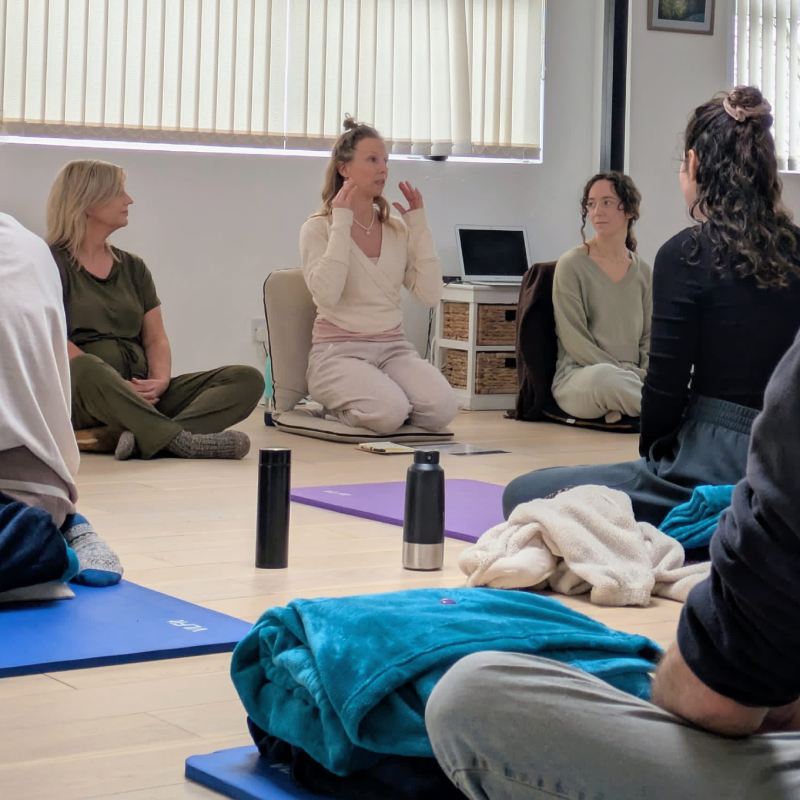
Holding space for others through conscious connected breathing is a beautiful, transformative responsibility. Yet as facilitators, we often focus so intently on supporting our clients that we can forget about our own internal state. Staying grounded is essential — not only for our wellbeing, but for the safety and quality of the sessions we offer.
Grounding helps us return to our own body, presence, and breath, even while guiding others through theirs. And paired with resourcing, it becomes a powerful foundation for delivering trauma-informed breathwork with integrity, clarity, and compassion.
What Is Grounding?
Grounding is the practice of bringing yourself back into the present moment and into your physical body.
It’s what helps you feel stable, settled, and connected to yourself, even when the energy in the room becomes intense or emotionally charged.
During breathwork, grounding might look like:
- noticing the feel of your feet on the floor
- softening your shoulders
- slowing your own breath
- placing a hand on your heart or belly
- orienting to the room and taking in your surroundings
Grounding is your anchor. It keeps you steady so you can hold steady space for others.
What Is Resourcing?
If grounding is the anchor, resourcing is the soft support that surrounds you.
Resourcing refers to the internal and external tools you draw on to feel safe, supported, and capable — especially when difficult emotions arise.
Internal resources
- your inner wisdom
- your resilience
- your intuition
- memories of safety or strength
- the sense of “I can handle this”
External resources
- a trusted colleague or mentor
- a calming piece of music
- a grounding object or crystal
- nature
- a weighted blanket
- a warm drink before or after a session
Resourcing is about tapping into these internal and external supports so you feel held, even while you’re holding space for others. It’s the reminder that you’re not alone, and you have what you need to navigate whatever arises.
Grounding vs. Resourcing — What’s the Difference?
Although grounding and resourcing work beautifully together, they serve slightly different purposes.
Grounding
- Brings you back into the here and now
- Connects you with your physical body
- Creates a sense of stability and safety
Resourcing
- Provides comfort, reassurance, and emotional support
- Helps you move through challenging experiences
- Builds resilience and ease in the face of intensity
Think of it like the structure of a home:
Grounding is the solid foundation — firm, stable, unwavering.
Resourcing is everything that makes the house feel like a home — the warm colours, the soft blankets, the artwork that inspires you.
Both are essential. One gives you steadiness; the other gives you nourishment.
Why Grounding and Resourcing Matter in Breathwork
During breathwork session, as a facilitator creating a safe and supportive container is paramount. Grounding and resourcing practices help to establish this container, offering individuals a sense of stability and control as they navigate their inner landscape.
Grounding techniques anchor us in the present moment, reminding us that we are safe and supported.
Resourcing techniques provide a sense of comfort and strength, allowing us to draw on our inner and outer resources when we encounter challenging emotions or sensations.
Together, these practices create the internal conditions for deep, meaningful work — without overwhelming the nervous system.
Why This Matters for Breathwork Facilitators?
Breathwork can bring up powerful emotions, insights, and sensations — not only for the people breathing but also for the person guiding them. Staying grounded and resourced allows you to hold space from a calm, steady, supportive place.
I personally find that if the energy in the room becomes strong or intense, I like to sit on the ground for a moment, take a slow breath, and feel the surface beneath me. That simple physical contact — the weight of my body meeting the floor — brings me back into myself.
I sometimes like to sit for a short moment behind my laptop while holding space, and even that subtle setup serves as a reminder of my role as a facilitator. It helps me return quickly to presence, clarity, and grounded awareness.
When you stay connected to your own breath and body:
- you remain calm, even when the session becomes emotionally charged
- you can respond rather than react
- you provide safety and containment for the client’s process
- your own nervous system remains regulated
- your presence becomes an anchor for everyone in the room
A grounded facilitator helps create a grounded client.
A resourced facilitator helps create a safe, nurturing environment for deep work.
In trauma-informed breathwork, these practices are at the heart of safe, sustainable facilitation.
Leave a Reply